
Plain-English guide · Last reviewed: September 2026
Quick facts
Item Detail Full name PM Surya Ghar: Muft Bijli Yojana Launched February 2024 Ministry Ministry of New and Renewable Energy (MNRE) Target 1 crore (10 million) households Maximum subsidy ₹78,000 (for 3 kW and larger systems) Free electricity Up to 300 units per month Official portal pmsuryaghar.gov.in
Electricity bills are one of the biggest monthly expenses for an Indian family. The PM Surya Ghar: Muft Bijli Yojana tackles this by putting solar panels on your own rooftop — and the government pays part of the cost.
This guide explains, in simple terms, what the scheme offers, who qualifies, how much subsidy you receive, and the exact steps to apply.
1. What is PM Surya Ghar Muft Bijli Yojana?
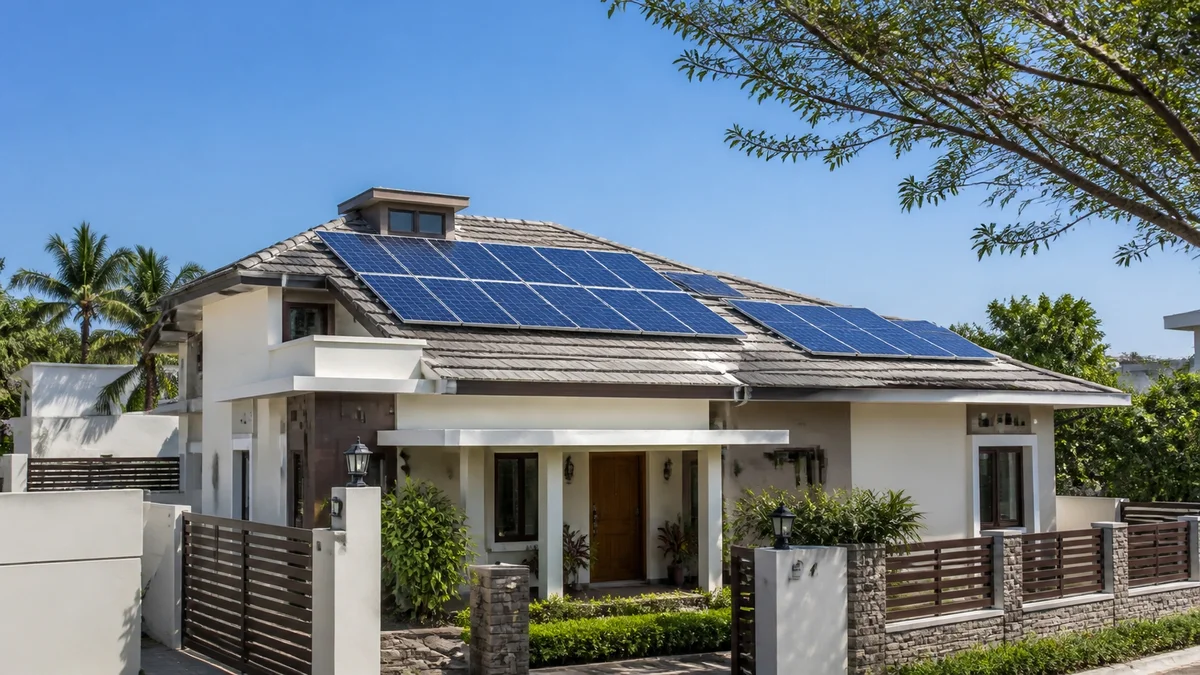
PM Surya Ghar is a Central government scheme that provides a direct subsidy to households installing rooftop solar systems. Instead of paying for generators or grid power every month, your home generates its own electricity from sunlight. The subsidy covers roughly 40% of the cost of the solar panels in most cases.
The scheme is large: the government approved a total outlay of ₹75,021 crore, with a target of bringing rooftop solar to 1 crore households across India [Source: myScheme].
It is already one of the most popular Central schemes — the official portal had crossed ~79.5 lakh registered households by August 2026, and media reports estimate that more than 40 lakh households are already running on home solar, with over ₹17,900 crore in subsidies paid out (as of mid-2026).
2. What do you get under the scheme?
- Up to 300 units of free electricity every month — enough to cover a typical Indian family’s usage in most months.
- A direct subsidy (cash benefit) to your bank account — this is the money you save on the upfront cost of the panels.
- Net metering or surplus billing — if your panels produce more power than you use, the surplus goes into the grid, and you earn credit on your next bills (rules differ slightly by state).
- Reliable, clean power — fewer power-cut headaches, and lower long-term costs once the system is installed.
3. How much subsidy do you get? (2026 slabs)
The subsidy is fixed per kilowatt (kW) of solar capacity. These are the official slabs:
| System size | Subsidy you get | Example |
|---|---|---|
| Up to 2 kW | ₹30,000 per kW | 1 kW → ₹30,000 · 2 kW → ₹60,000 |
| 3 kW | ₹30,000/kW on first 2 kW + ₹18,000 on the 1 extra kW | ₹78,000 total |
| Above 3 kW up to 10 kW | Capped at ₹78,000 | 5 kW → still ₹78,000 |
| Above 10 kW | Not eligible for subsidy | — |
Source: pmsuryaghar.gov.in.
So, for most homes, the practical numbers are: ₹30,000 per kW for a 1–2 kW system, and up to ₹78,000 for a 3 kW (or larger) system.
A typical 3 kW installation costs roughly ₹1.5–2.2 lakh depending on your city, the vendor, and bank loan options — the ₹78,000 subsidy and a cheaper solar loan usually leave a manageable amount to pay. Always get 2–3 quotes from registered vendors and compare.
4. Who is eligible?
- You must be a citizen of India.
- You must own the house — the roof must belong to you (renters cannot apply).
- The house must have an existing electricity connection (grid connection).
- Your roof must be suitable — mostly unshaded, sturdy enough to mount panels.
- The subsidy is intended to be applied once per household (one residential system per house).
- Some states add their own top-up subsidy on top of the Central one — check your state’s power utility (DISCOM) page.
5. Documents you will need
Keep these ready before applying:
- Aadhaar card (identity + bank linkage)
- Latest electricity bill (your consumer number)
- Bank account details (passbook/bank details linked to Aadhaar, because the subsidy is paid by direct bank transfer)
- Proof of house ownership (as per your state’s utility requirement)
- A recent passport-size photo (for the online form)
💡 Related reading: Complete document checklist for government schemes · How to update bank details for scheme payments
6. How to apply — step by step
- Register on the official portal pmsuryaghar.gov.in using your mobile number (OTP verification).
- Submit the rooftop application — select your state/DISCOM and enter your electricity consumer number and bill details.
- Wait for feasibility approval — the DISCOM checks your roof, connection, and net-metering arrangements. Approval normally takes a week or two.
- Choose a registered vendor from the portal’s empanelled vendor list and get quotes — do not hire random unregistered installers (see the scam warning below).
- Install the system, then have the DISCOM install the net meter and inspect the setup.
- Apply for the subsidy on the consumer portal — submit your installation details and bank account information; the subsidy is paid via direct bank transfer (DBT) after successful commissioning, usually within a few weeks.
7. How to check your application status
Use the consumer login on the official consumer portal: consumer.pmsuryaghar.gov.in. You can track each stage — application → feasibility → vendor assignment → installation → net meter → subsidy release. Keep the mobile number you registered with handy.
8. Scams and mistakes to avoid
- The scheme never charges money to register or apply. Any agent who asks for a “processing fee” is scamming you. See: Government scheme applications are free — know the truth and how to avoid government scheme fraud.
- Never share your OTP, Aadhaar, or bank details with anyone who calls claiming to be from the ministry.
- Only use vendors listed on the official portal — bogus vendors disappear after taking your advance payment.
- If your subsidy is delayed, raise a complaint on the consumer portal instead of paying anyone to “speed it up”.
9. Fresh update: PM Surya Ghar 2.0 (2026)
There are reports that the next phase — PM Surya Ghar 2.0 — will link future subsidies to actual electricity generation, battery storage, lifecycle maintenance, and service quality (reported July 2026 Source: Financial Express).
If you have already registered, your application follows the current rules — but before installing, check the portal for the latest 2.0 announcements, because the benefit structure may change.
10. Frequently Asked Questions
Q1. Does the subsidy go to the vendor or to me?
It goes directly to your Aadhaar-linked bank account (DBT) after the system is installed and commissioned. Some vendors offer a “discount now, collect subsidy later” deal — read the terms before signing.
Q2. I rent my house — can I apply?
No. The scheme is for homeowners only. However, you could ask your landlord to install the system (the benefit stays with the owner).
Q3. My roof has heavy shading — can I still apply?
The DISCOM’s feasibility check will tell you. Heavy shading reduces generation and can make the system unviable — the same check also protects you from a bad decision.
Q4. Is a battery included in the subsidy?
The current scheme mainly subsidizes the solar panels and grid-connected setup; batteries usually cost extra. Battery support is expected to be part of PM Surya Ghar 2.0 — watch the official portal.
Q5. How long does the subsidy take to arrive?
Usually a few weeks after installation and the net meter/inspection. Track it on the consumer portal and raise a complaint if it crosses a month with no update.
Q6. Can I sell the extra power I generate?
Yes — under net metering, surplus units are exported to the grid and give you credit on your electricity bill (rates set by your state).
Sources & freshness note
- Official portal: pmsuryaghar.gov.in · Consumer portal: consumer.pmsuryaghar.gov.in · myScheme page (pmsgmb)
- PIB — PM Surya Ghar overview · Financial Express — Surya Ghar 2.0 report (July 2026)
This article is for information only. Always confirm current rules and amounts on official government portals before applying.