

Introduction
Imagine securing your family’s financial future with a ₹2 lakh life insurance cover for just ₹436 a year. That’s exactly what the Pradhan Mantri Jeevan Jyoti Bima Yojana (PMJJBY) offers.
Launched by the Government of India in 2015, PMJJBY is designed to make life insurance affordable and accessible, especially for low- and middle-income families.
The scheme provides a ₹2 lakh payout to the nominee if the insured person dies from any cause, whether due to illness, natural causes, or an accident.
The policy is renewed annually, and the premium is automatically deducted from the subscriber’s bank or post office account.
Whether you’re hearing about PMJJBY for the first time or want to know how to enroll, renew your policy, or make a claim, this guide explains everything in plain English.
At a Glance
| Feature | Details |
|---|---|
| Scheme | Pradhan Mantri Jeevan Jyoti Bima Yojana (PMJJBY) |
| Type | Government-backed annual term life insurance |
| Coverage | ₹2 lakh |
| Premium | ₹436 per year |
| Entry Age | 18–50 years |
| Renewal | Up to age 55, subject to annual renewal |
| Risk Covered | Death due to any cause |
| Policy Period | 1 June to 31 May |
| Premium Payment | Auto-debit from bank/post office account |
| Implemented Through | Participating banks/post offices with LIC and other participating life insurers |
What Is PMJJBY?
The Pradhan Mantri Jeevan Jyoti Bima Yojana (PMJJBY) is a government-supported one-year renewable term life insurance scheme aimed at expanding life insurance coverage across India.
Unlike many private life insurance policies that may require medical examinations or involve higher premiums, PMJJBY offers a simple and affordable way for eligible bank account holders to obtain basic life insurance.
If the insured subscriber dies while the policy is active, the nominee receives ₹2 lakh, regardless of whether the death was due to illness, natural causes, or an accident.
Why Was PMJJBY Introduced?
Before PMJJBY, millions of Indians—particularly those in rural areas and lower-income households—had no life insurance because of cost, lack of awareness, or limited access.
The Government introduced PMJJBY to:
- Increase financial security for families.
- Promote financial inclusion.
- Provide affordable life insurance.
- Reduce the financial impact of the death of an earning member.
- Encourage wider participation in formal financial services.
The scheme complements other social security initiatives such as the Pradhan Mantri Suraksha Bima Yojana (PMSBY) and the Atal Pension Yojana (APY).
Latest PMJJBY Updates (2026)
Here are the key points subscribers should know in 2026:
- Annual premium remains ₹436.
- Life insurance cover remains at ₹2 lakh.
- Entry age remains 18 to 50 years.
- Coverage can continue up to age 55, provided the policy is renewed annually.
- The insurance period runs from June 1 to May 31 each year.
- New subscribers joining after the annual renewal period may pay a pro-rata premium, depending on the month of enrolment.
- PMJJBY has crossed 27 crore cumulative enrolments, with more than 10 lakh claims settled, reflecting the scheme’s widespread adoption.
Why PMJJBY Matters
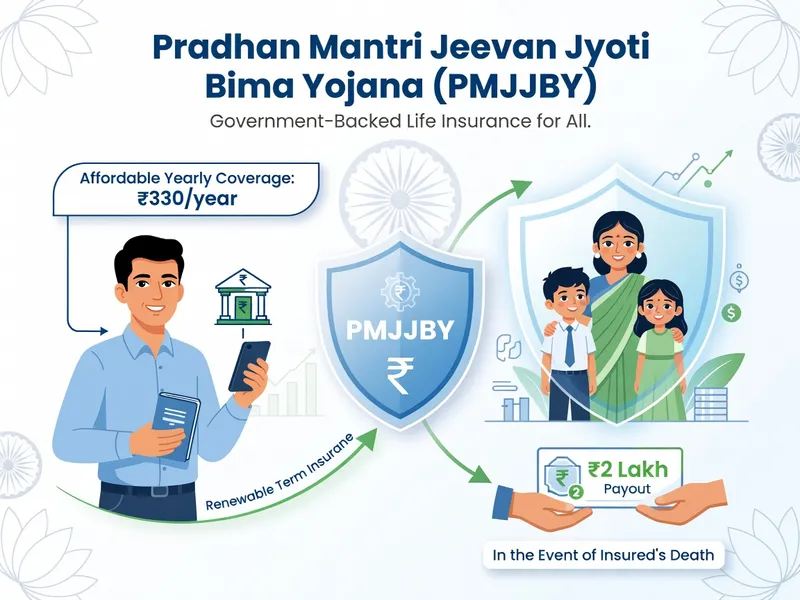
Many families depend on a single earning member. If that person dies unexpectedly, the family may struggle with everyday expenses, loan repayments, or children’s education.
While ₹2 lakh may not replace a comprehensive term insurance policy, it can provide immediate financial support when it is needed most. Because the premium is only ₹436 per year, PMJJBY remains one of the most affordable life insurance options available in India.
Perfect. Let’s continue building this into a publication-ready pillar article.
PMJJBY Eligibility, Benefits, Premium & Coverage
Who Is Eligible for PMJJBY?
To enroll in the Pradhan Mantri Jeevan Jyoti Bima Yojana (PMJJBY), you must satisfy the following eligibility conditions.
| Requirement | Details |
|---|---|
| Age | 18 to 50 years (completed age) |
| Bank/Post Office Account | Must have an active savings account with a participating bank or post office |
| Consent | Must authorize annual premium auto-debit |
| KYC | The savings account should comply with KYC requirements (Aadhaar is commonly used as the primary KYC document) |
Once enrolled before turning 51, you can continue to renew the policy each year until age 55, provided the premium is deducted each year.
Quick Eligibility Checklist
You are eligible if you answer “Yes” to all of these questions:
- ✔ Are you between 18 and 50 years old?
- ✔ Do you have an individual savings bank or post office account?
- ✔ Is your account active?
- ✔ Are you willing to allow annual auto-debit of the premium?
- ✔ Have you enrolled through only one account?
If yes, you can join PMJJBY.
Can You Continue After Age 50?
This is one of the most common questions.
Yes.
Many people assume the policy ends when they turn 50, but that’s not correct.
- You can join only up to age 50.
- Once enrolled, you may renew the policy each year until age 55, as long as your coverage has not lapsed and the premium remains paid.
Example
| Age | Can Join? | Can Continue? |
|---|---|---|
| 24 | ✔ Yes | ✔ Yes |
| 35 | ✔ Yes | ✔ Yes |
| 49 | ✔ Yes | ✔ Yes |
| 50 | ✔ Yes | ✔ Yes |
| 52 | ❌ New enrolment not allowed | ✔ Renewal allowed |
| 56 | ❌ | ❌ Coverage ends |
Who Cannot Join PMJJBY?
You cannot enroll if:
- You are below 18 years of age.
- You are above 50 years and have never enrolled before.
- You do not have an eligible savings bank or post office account.
- You do not consent to auto-debit of the premium.
- You attempt to enroll through multiple accounts. If multiple enrollments are detected, insurance cover is limited to one policy, and excess premiums may be forfeited in accordance with scheme rules.
Can NRIs Join PMJJBY?
Yes.
Non-Resident Indians (NRIs) can enroll if they:
- have an eligible savings account with a participating bank or post office in India, and
- meet all other scheme conditions.
Any claim is payable to the nominee in accordance with the scheme rules.
What Benefits Does PMJJBY Provide?
PMJJBY offers a simple benefit.
If the insured subscriber dies while the policy is active, the nominee receives a lump-sum payment of ₹2 lakh.
The cause of death may include:
- Natural death
- Illness
- Heart attack
- Cancer
- Stroke
- Infection
- Old-age-related illness
- Road accident
- Train accident
- Air accident
- Drowning
- Fire
- Other covered causes
Unlike accident-only insurance, PMJJBY covers death due to any cause, subject to the scheme rules, including the initial lien period for new enrollments.
What Is Not Covered?
Although PMJJBY is generous for its cost, there are important limitations.
The scheme does not provide:
- Survival or maturity benefits.
- Money-back benefits.
- Disability benefits.
- Hospitalization expenses.
- Treatment costs for illnesses.
- Critical illness cover.
- Accidental disability compensation (that is covered under PMSBY, not PMJJBY).
Think of PMJJBY as pure life insurance—it pays only if the insured dies while the cover is in force.
PMJJBY Premium Explained
The annual premium remains ₹436 per member.
The premium is:
- deducted automatically from your savings account,
- usually once every year before the new policy period begins,
- payable through the auto-debit mandate you authorize while enrolling.
What Does ₹436 Buy?
For less than ₹1.20 per day, the scheme provides:
- ₹2 lakh life insurance
- Coverage for death due to any cause
- No medical examination in normal circumstances
- Easy annual renewal through auto-debit
This makes PMJJBY one of India’s most affordable life insurance schemes.
What If You Join Mid-Year?
If you enroll for the first time after the policy year has started, you may pay a pro-rata premium.
| Month of First Enrolment | Premium Payable |
|---|---|
| June–August | ₹436 |
| September–November | ₹342 |
| December–February | ₹228 |
| March–May | ₹114 |
At the next renewal, the full annual premium of ₹436 becomes payable.
Policy Period
PMJJBY follows a fixed insurance year.
| Policy Starts | Policy Ends |
|---|---|
| 1 June | 31 May (next year) |
For example:
- Coverage begins during the applicable policy year following successful enrollment and the commencement of risk.
- The policy remains valid until May 31.
- It must then be renewed for the next year.
When Does the Insurance Cover Start?
This is another point that often confuses subscribers.
For first-time subscribers, the insurance risk generally begins from the date the premium is successfully auto-debited. However, there is an important waiting period (called the lien period) for non-accidental deaths.
Understanding the 30-Day Lien Period
The lien period is a 30-day waiting period that applies to new enrollments (and to certain re-enrollments after leaving the scheme).
During these first 30 days:
- Accidental death is covered immediately.
- Death from causes other than an accident is not covered.
If a subscriber dies from illness or natural causes during this 30-day period, no claim is payable. Once the 30 days are over, coverage extends to death due to any cause while the policy remains active.
Example
| Situation | Claim Payable? |
|---|---|
| Road accident on Day 10 after enrollment | ✔ Yes |
| Heart attack on Day 15 after enrollment | ✘ No |
| Cancer-related death after Day 45 | ✔ Yes |
| Natural death six months later | ✔ Yes |
Key Takeaways
- Join between 18 and 50 years of age.
- Continue renewing up to 55 years if eligible.
- Only one enrollment is allowed per person.
- Annual premium is ₹436.
- Coverage is ₹2 lakh for death due to any cause.
- Mid-year enrollment may qualify for a reduced pro-rata premium.
- A 30-day lien period applies to new enrollments for non-accidental deaths.
Excellent. This is one of the most practical sections of the article, and it’s also where many competing articles are weak. We’ll explain every step in plain English.
How to Apply for PMJJBY (Step-by-Step Guide)
Joining PMJJBY is simple. You don’t need to visit multiple offices or undergo a medical examination in normal cases. Enrollment is available through participating banks and post offices that have tied up with Life Insurance Corporation (LIC) or other participating life insurers.
There are several ways to enroll.
Method 1: Through Your Bank Branch
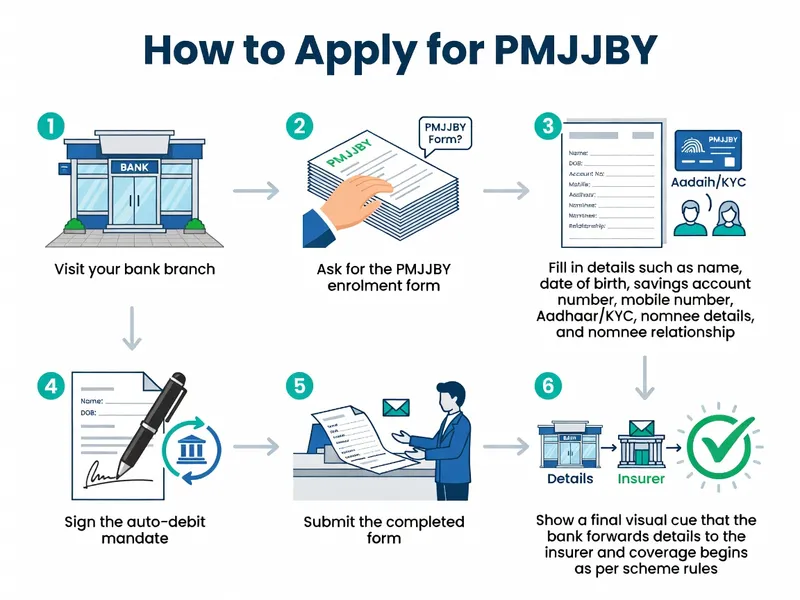
This is the most common option.
Step 1
Visit the branch where you maintain your savings account.
Step 2
Ask for the PMJJBY Enrolment (Consent-cum-Declaration) Form.
Step 3
Fill in:
- Name
- Date of Birth
- Savings Account Number
- Mobile Number
- Aadhaar (where applicable as KYC)
- Nominee details
- Relationship with nominee
Step 4
Sign the auto-debit mandate authorizing the bank to deduct the annual premium from your account.
Step 5
Submit the completed form.
Once accepted, your bank forwards the details to the insurer and your insurance cover starts as per the scheme rules.
Method 2: Through Internet Banking
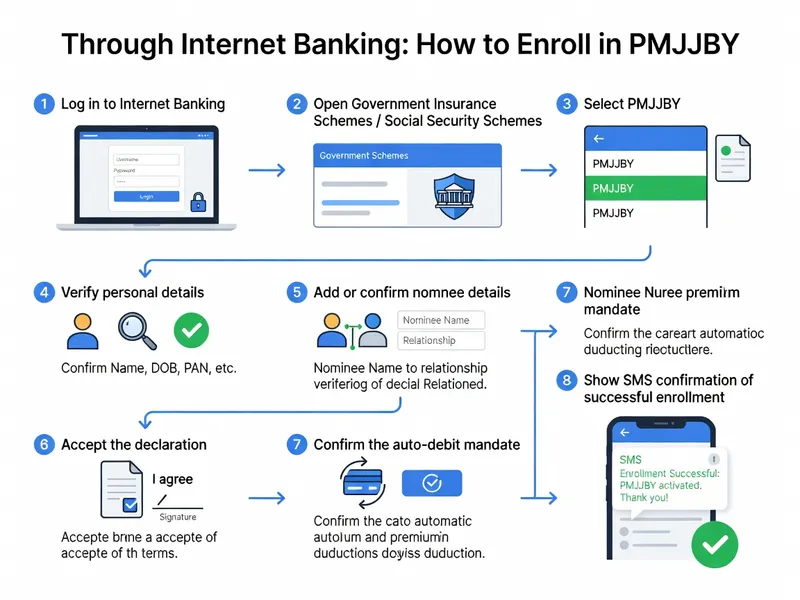
Many banks allow customers to enroll online.
Typical process:
- Log in to Internet Banking.
- Open the Government Insurance Schemes or Social Security Schemes section.
- Select PMJJBY.
- Verify your personal details.
- Add or confirm nominee details.
- Accept the declaration.
- Confirm the auto-debit mandate.
Some banks also send an SMS confirming successful enrollment.
Note: The exact menu names may vary from one bank to another.
Method 3: Through Mobile Banking
Several banks offer PMJJBY enrollment through their mobile apps.
Typical steps include:
- Open your banking app.
- Navigate to Government Schemes, Insurance, or Social Security.
- Choose PMJJBY.
- Confirm your details.
- Accept the declaration.
- Authorize auto-debit.
The interface differs across banks, but the overall process is similar.
Method 4: Through India Post
If you maintain an eligible Post Office Savings Account, you can also enroll through participating post offices. The process is similar to that followed by banks.
Documents Required
One advantage of PMJJBY is that documentation is minimal.
| Document | Required? |
|---|---|
| Savings account | ✔ Yes |
| Aadhaar or other KYC document linked to the account | ✔ Usually required for KYC |
| Mobile number | ✔ Recommended |
| Nominee details | ✔ Yes |
| Auto-debit consent | ✔ Mandatory |
| Medical examination | ✘ Not normally required |
Is Aadhaar Mandatory?
Aadhaar is generally used as the primary KYC document for the linked bank account. However, enrollment depends on your bank’s KYC compliance requirements, not on a separate Aadhaar submission under PMJJBY.
Why Is the Auto-Debit Mandate Important?
PMJJBY works on an annual auto-debit system.
Instead of remembering to pay the premium every year, you authorize your bank or post office to deduct it automatically.
This helps ensure your insurance remains active without requiring a manual renewal each year.
If there isn’t enough money in your account when the premium is due, the debit may fail, and your coverage can lapse.
Choosing a Nominee
A nominee is the person who receives the insurance amount if the insured dies.
You can nominate:
- Spouse
- Son
- Daughter
- Mother
- Father
- Brother
- Sister
- Any other legally eligible person
Choose someone you trust and keep the nomination up to date.
Can You Change Your Nominee Later?
Yes.
Life circumstances change. You may get married, have children, or wish to nominate someone else.
To update your nominee:
- Visit your bank or post office.
- Request the nomination modification form or procedure.
- Submit the revised nominee details.
- Keep a copy of the acknowledgment for your records.
Many banks also allow nomination updates through their customer service channels.
How to Check Whether You Are Already Enrolled
Sometimes people are unsure whether they previously joined PMJJBY.
You can verify your status by:
- Checking your bank statement for the annual premium debit.
- Reviewing SMS or email alerts from your bank.
- Contacting your home branch.
- Checking through your bank’s Internet Banking or Mobile Banking portal (if supported).
- Using the Jan Suraksha policy search facility, where available.
How to Renew PMJJBY
PMJJBY is a one-year renewable policy.
Renewal is usually automatic if:
- your bank account remains active,
- you continue to meet the scheme conditions, and
- sufficient balance is available for the annual premium deduction.
The policy generally runs from June 1 to May 31, with renewal occurring around the start of the new policy year.
What Happens If the Premium Is Not Deducted?
If the premium cannot be debited—for example, because your account has insufficient funds or has been closed—the insurance cover may terminate.
If this happens:
- no insurance protection is available during the lapse period, and
- you may need to rejoin the scheme by submitting the required declaration and paying the applicable premium, subject to the scheme rules.
Can You Rejoin After a Policy Lapses?
Yes.
Subscribers who discontinue PMJJBY can generally rejoin later, provided they are otherwise eligible and comply with the prevailing scheme requirements, including any required declaration of good health and applicable waiting-period provisions.
Practical Tips for Readers
✔ Keep at least ₹500 in your account during the renewal period to avoid a failed premium debit.
✔ Save the enrollment acknowledgment or SMS confirmation.
✔ Review your nominee details after major life events such as marriage or the birth of a child.
✔ Check your bank statement every year to confirm that the premium has been successfully deducted.
Great. This is the heart of the article. If we explain the claims process clearly, your guide will be genuinely helpful to families who may need to file a claim during a difficult time.
PMJJBY Claim Process: Step-by-Step Guide
If a PMJJBY subscriber dies while the policy is active, the nominee (or, if there is no valid nominee, the legal heir) can submit a claim to receive the ₹2 lakh insurance benefit. Claims are initiated through the bank or post office where the subscriber enrolled, which coordinates with the insurer.
Subscriber dies
        │
        ▼
Nominee informs the bank/post office
        │
        ▼
Collect and complete the PMJJBY Claim-cum-Discharge Form
        │
        ▼
Attach all required documents
        │
        ▼
Submit documents to the bank/post office
        │
        ▼
Bank verifies the claim
        │
        ▼
Insurer reviews the claim
        │
        ▼
₹2 lakh credited to the nominee's bank account
Step 1: Inform the Bank or Post Office
As soon as possible after the subscriber’s death, the nominee should visit the bank branch or post office where the PMJJBY policy was enrolled.
The staff will:
- verify that the subscriber was covered under PMJJBY,
- provide the required claim forms, and
- explain the documentation needed.
Step 2: Obtain the Claim Form
The required form is called the Claim-cum-Discharge Form.
It can be obtained:
- from the bank branch,
- from the participating insurer, or
- by downloading it from the official Jan Suraksha portal.
Official PMJJBY Claim Form
PMJJBY Claim-cum-Discharge Form (PDF)
Step 3: Complete the Claim Form
The nominee should fill in details such as:
- Name of the deceased
- PMJJBY subscriber details
- Bank account number
- Date of death
- Cause of death
- Nominee’s name
- Address
- Mobile number
- Bank details for receiving the claim amount
Before submitting, double-check that all information matches the bank’s records.
Step 4: Attach Supporting Documents
The required documents are usually straightforward.
| Document | Required |
|---|---|
| Completed Claim-cum-Discharge Form | ✔ |
| Death Certificate | ✔ |
| Copy of the deceased’s bank passbook or account details (if requested by the bank) | ✔ |
| Nominee’s identity proof | ✔ |
| Nominee’s bank account details | ✔ |
| Any additional documents requested by the bank or insurer | If applicable |
The exact document requirements may vary slightly depending on the insurer or the circumstances of the claim. (Jan Suraksha)
Step 5: Bank Verification
After receiving the application, the bank or post office:
- checks that the subscriber was covered,
- verifies that the premium had been deducted,
- confirms the nominee details,
- reviews the submitted documents, and
- forwards the claim to the insurer if everything is in order.
Step 6: Insurance Company Verification
The insurer then verifies:
- policy status,
- eligibility,
- documents,
- nominee details,
- and compliance with the scheme rules.
If clarification is required, the insurer may request additional information from the bank.
Step 7: Claim Settlement
Once the claim is approved, the insurer transfers the ₹2 lakh directly to the nominee’s bank account.
The nominee does not receive cash; payment is made through the banking system.
How Long Does Settlement Take?
The time depends on:
- whether all documents are complete,
- how quickly the bank verifies the claim,
- and whether additional clarification is required.
Straightforward claims with complete documentation are generally processed faster than claims with missing information. There is no single statutory timeline that applies to every case under PMJJBY, so submitting a complete application helps avoid delays.
Is There a Time Limit for Filing a Claim?
The nominee should inform the bank and submit the claim as soon as reasonably possible after the subscriber’s death.
Although delays may be accepted in genuine circumstances, prolonged waiting can make document verification more difficult. It is best not to postpone the claim unnecessarily.
Practical Tip: Aim to start the claim process within a few weeks of the death, once the death certificate is available.
Common Reasons for Claim Delays or Rejection
Claims may be delayed or rejected if:
- The policy had lapsed because the premium was not successfully deducted.
- The subscriber was not eligible under the scheme rules.
- The subscriber had enrolled through more than one account.
- The death occurred during the 30-day lien period for a non-accidental cause.
- Required documents are incomplete or inconsistent.
- Nominee details do not match the bank’s records.
Example 1: Successful Claim
Ramesh (Age 42)
- Joined PMJJBY in 2023.
- Premium deducted every year.
- Died due to a heart attack in July 2026.
- His wife was the registered nominee.
Result: After submitting the required documents, the insurer approved the claim and ₹2 lakh was credited to the nominee’s bank account.
Example 2: Claim Not Payable
Anil (Age 36)
- Enrolled in PMJJBY.
- Died due to illness 15 days after enrollment.
Since the death occurred during the 30-day lien period and was not accidental, the claim would not be payable under the scheme rules.
Example 3: Accidental Death During the Lien Period
Suresh (Age 28)
- Joined PMJJBY.
- Died in a road accident 12 days after enrollment.
Because accidental deaths are covered from the commencement of risk, the nominee would generally be eligible for the ₹2 lakh benefit, subject to compliance with the scheme rules.
Tips for a Smooth Claim Process
✔ Inform the bank promptly.
✔ Obtain the official death certificate as early as possible.
✔ Keep copies of all submitted documents.
✔ Ensure the nominee’s bank account is active.
✔ Ask the bank for an acknowledgment when you submit the claim.
✔ Keep your contact number updated with the bank.
Helpful Resources
- Official PMJJBY Scheme Page (Department of Financial Services)
- Official Jan Suraksha Portal
- PMJJBY Claim Form (PDF)
Who Should Enroll in PMJJBY?
PMJJBY is designed to provide affordable life insurance for people who may not have access to expensive private insurance plans. While the ₹2 lakh cover may not meet all of a family’s long-term financial needs, it can provide valuable financial support during a difficult time.
The scheme is particularly suitable for:
- Salaried employees without adequate life insurance
- Self-employed individuals and small business owners
- Farmers and agricultural workers
- Daily wage earners and labourers
- Homemakers who contribute to household income
- Young adults starting their careers
- Senior citizens below the entry age who have not yet enrolled
- Anyone looking for a low-cost basic life insurance cover
At an annual premium of ₹436, PMJJBY offers one of the most affordable life insurance options available in India.
Advantages and Limitations
| Advantages | Limitations |
|---|---|
| Affordable premium of ₹436 per year | Coverage is limited to ₹2 lakh |
| Covers death due to any cause (subject to scheme rules) | No maturity or survival benefit |
| Simple enrollment process | No disability or hospitalization benefits |
| No medical examination in normal cases | Entry only between 18 and 50 years |
| Automatic annual renewal through auto-debit | Cover generally ends after age 55 |
| Available through participating banks and post offices | Dependent on successful premium deduction every year |
Expert Tip: Think of PMJJBY as a foundation—not a complete financial protection plan. If your family depends on your income, consider supplementing it with a suitable term life insurance policy based on your financial responsibilities.
FAQs
Include around 25–30 FAQs with concise answers. Examples:
1. What is PMJJBY?
PMJJBY is a government-backed annual renewable life insurance scheme that provides ₹2 lakh cover for death due to any cause, subject to the scheme rules.
2. What is the annual premium?
The annual premium is ₹436.
3. What is the maximum insurance cover?
₹2 lakh.
4. Who can join PMJJBY?
Individuals aged 18 to 50 years with an eligible savings bank or post office account.
5. Can I continue after turning 50?
Yes. If you enrolled before age 51 and continue to renew, you may remain covered for up to 55 years.
.
Key Takeaways
Before you leave, remember these important points:
- ✔ PMJJBY provides ₹2 lakh life insurance cover.
- ✔ The annual premium is ₹436.
- ✔ Entry age is 18–50 years.
- ✔ Eligible subscribers can renew the policy up to 55 years.
- ✔ The scheme covers death due to any cause, subject to the scheme rules.
- ✔ Enrollment is available through participating banks and post offices.
- ✔ The premium is usually deducted automatically from the linked account.
- ✔ Keep sufficient balance in your account each year to avoid lapse of coverage.
- ✔ Update your nominee details whenever your family circumstances change.
Final Verdict

PMJJBY is one of India’s most affordable life insurance schemes, offering ₹2 lakh of financial protection for just ₹436 a year. For many households, especially those with limited financial resources, it provides an important safety net that can help the family cope with the immediate financial impact of the earning member’s death.
However, the ₹2 lakh cover should be viewed as basic protection rather than comprehensive life insurance. Families with significant financial responsibilities—such as home loans, education expenses, or long-term income replacement needs—should consider PMJJBY as a supplement to a suitable term insurance policy rather than a replacement.
If you meet the eligibility criteria and are not yet enrolled, PMJJBY is a simple and cost-effective way to strengthen your family’s financial security.
Official Resources
For the latest information, forms, and scheme guidelines, refer to the official government resources:
- Department of Financial Services – PMJJBY
- Jan Suraksha Portal
- Participating Bank or Post Office Branch
- Life Insurance Corporation of India (LIC) or the participating insurer linked to your bank
Related Articles
Help readers explore other government-backed financial protection schemes:
- PMSBY (Pradhan Mantri Suraksha Bima Yojana): Complete Guide
- Atal Pension Yojana (APY): Eligibility, Benefits & Contribution Chart
- PMJDY (Pradhan Mantri Jan Dhan Yojana): Complete Guide
Last Reviewed: July 2026
Next Scheduled Review: January 2027 (or earlier if the Government announces changes)
Reviewed Against: Department of Financial Services guidelines, Jan Suraksha Portal, and participating insurer information.This guide is for informational purposes only and does not constitute financial or legal advice. While we have endeavored to provide accurate and up-to-date information based on official government sources, scheme rules and benefits may change. For the most current and binding information, please consult the Department of Financial Services, your participating bank, or the Jan Suraksha portal. The author and Haqdaar are not responsible for any errors, omissions, or decisions made based on this guide.