
Quick Answer
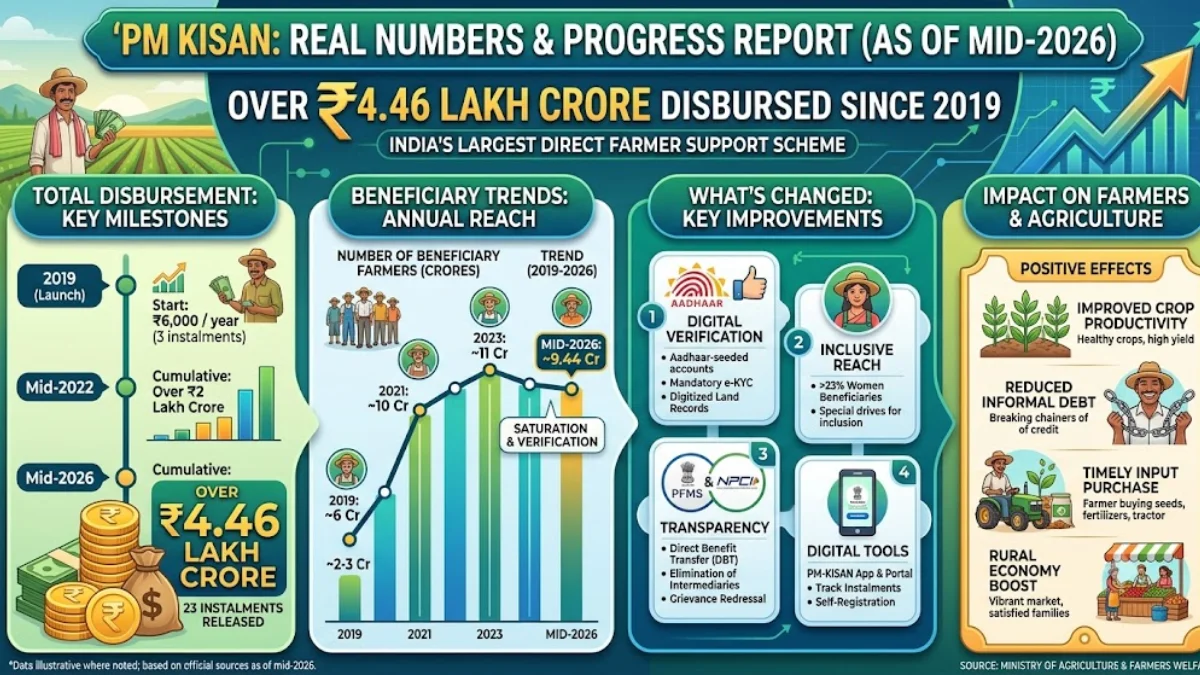
As of the 22nd installment (March 2026), the government has transferred over ₹4.27 lakh crore to farmer families since PM Kisan launched in 2019. The most recent installment — the 23rd, released 20 June 2026 — sent ₹18,880 crore to 9.44 crore farmers in a single day.
A quick timeline
PM Kisan launched in February 2019, with benefits applied retrospectively from December 1, 2018. It pays eligible farmer families ₹6,000 a year, split into three installments of ₹2,000 each, roughly every four months.
Coverage grew quickly in the early years — from 3.16 crore beneficiaries in the very first installment to a peak of 10.48 crore by the 11th installment. After that peak, the government ran a verification and de-duplication drive to remove ineligible or duplicate entries, which brought the active beneficiary count down before it stabilized. By the 19th installment (December 2024–March 2025), the count had climbed back to 10.07 crore. The four most recent installments have settled into a narrower band, running between 9.32 and 9.71 crore farmers per cycle.
As of June 2026, 23 installments have been released. Over 11 crore farmer families have received at least one payment since the scheme began — a larger figure than any single installment, since it counts everyone ever covered, not just those currently active.
Key numbers at a glance
| Metric | Figure | As of |
|---|---|---|
| Instalments released | 23 | June 2026 |
| Cumulative disbursed | Over ₹4.27 lakh crore | March 2026 (22nd installment) |
| Latest installment amount | ₹18,880 crore | 20 June 2026 (23rd installment) |
| Latest instalment beneficiaries | 9.44 crore farmers | 20 June 2026 |
| Peak single-installment coverage | 10.48 crore farmers | 11th instalment |
| Total unique families ever covered | Over 11 crore | Since inception (2019) |
| Per-payment amount | ₹2,000 | Each of 3 instalments/year |
Read our PM-KISAN Eligibility 2026 guide to check whether you remain eligible under the scheme.
A note on precision: cumulative disbursement figures reported across different sources vary slightly depending on the exact reporting date used — this is normal for a rapidly updating DBT program, not a sign of unreliable data. The figures above use the most recent, most specific numbers available from ministry announcements and PIB coverage. Before publishing, cross-check the exact current cumulative total directly on pib.gov.in or the PM Kisan dashboard, since a newer installment may have been released since this was written.
What’s changed recently
Beneficiary count fluctuation, explained
The dip from the 10-crore-plus peak to the current ~9.3–9.4 crore range isn’t a funding cut — it reflects ongoing verification drives removing ineligible or duplicate entries (institutional landholders, deceased beneficiaries, incorrect land records, and similar cleanup). A shrinking beneficiary count here is generally a transparency and accuracy improvement, not a reduction in support for genuinely eligible farmers.
AgriStack and the Unique Farmer ID
The government is phasing in a new digital farmer identification system under the broader AgriStack framework. Existing PM Kisan beneficiaries are being migrated gradually, but new applicants may already need a Unique Farmer ID to register — worth checking current requirements before assuming the older registration process still applies unchanged.
Digital support tools
A 24/7 AI chatbot (Kisan-eMitra) now handles status and payment queries in 11 major Indian languages, integrated directly with the scheme. A separate initiative, described in government communications as a localized, phone-based farming advisory service, aims to provide farmers with scheme updates and farming guidance in their own language via a simple phone call — relevant to farmers without reliable internet access.
Demographic detail
The 22nd installment specifically reported that over 2.15 crore women farmers received payments — a detail worth noting, given how often “farmer” defaults to a male-coded image in general discussion, even though the scheme’s own data shows a substantial share of beneficiaries are women.
What independent research says
Beyond the government’s own figures, independent impact evaluations — cited by NITI Aayog and IFPRI (the International Food Policy Research Institute) — have found that a large majority of surveyed beneficiaries report reduced reliance on informal credit and moneylenders for agricultural inputs, and high overall satisfaction with the scheme.
This kind of third-party validation matters more than self-reported government statistics alone, since it comes from researchers with no institutional stake in showing the scheme in a positive light.
Context worth keeping in mind: over 85% of Indian farmers own less than two hectares of land. PM Kisan’s flat ₹6,000 payment, unlike land-size-scaled subsidies, means this group — the large majority of Indian farmers — gets support without needing to clear a scale threshold that would exclude smallholders.
Future outlook
The 24th installment, following the established four-month cycle, is expected in the October–November 2026 window, though the government hasn’t announced an exact date as of this writing.
The continued rollout of AgriStack and the Unique Farmer ID system is likely to keep affecting registration requirements and beneficiary counts through the rest of 2026 — worth monitoring for anyone not yet enrolled.
Budget allocations for the scheme are set annually in the Union Budget; check the current year’s Ministry of Agriculture and Farmers Welfare allocation directly for confirmed year-ahead figures rather than relying on a projected estimate here.
See our step-by-step guide on how to check PM-KISAN beneficiary status online.
PM Kisan Progress Report 2026: FAQs
Why did the number of beneficiaries drop after the scheme’s early years?
Mainly due to verification and de-duplication drives removing ineligible entries — institutional landholders, deceased beneficiaries, and duplicate or incorrect records — rather than a reduction in the scheme’s actual funding or ambition.
Is the money actually reaching farmers, or is this just an announced figure?
The disbursement figures are Direct Benefit Transfer payments — money credited directly into Aadhaar-seeded bank accounts, not just budgetary allocations. Independent research (NITI Aayog, IFPRI) on beneficiary outcomes provides a further check beyond the raw disbursement numbers themselves.
How is the cumulative disbursement figure calculated?
It’s the running total of every installment paid out since the scheme’s first release in 2019, summed across all 23 installments to date.
Does the growing requirement for a Unique Farmer ID mean I need to re-register?
Existing beneficiaries are being migrated into the new system gradually rather than required to restart registration, but this is an evolving process — check your status on the official portal if you’re unsure where you stand.
Where can I verify these figures myself?
The PM Kisan portal (pmkisan.gov.in) publishes installment-wise data, and PIB press releases (pib.gov.in) announce each installment’s exact figures on release day — both are more authoritative and more current than any secondary summary, including this one.
Is PM Kisan the largest scheme of its kind in the world?
It’s frequently described as one of the world’s largest Direct Benefit Transfer programs by number of beneficiaries, given its scale of 9+ crore active recipients per cycle.
Last verified: July 2026, using figures reported as of the 22nd and 23rd installments (March and June 2026, respectively). Cumulative and per-installment figures should be re-confirmed against pib.gov.in or the official PM Kisan dashboard before publishing, given how quickly these numbers move. This is independent informational content, not affiliated with the Government of India.