Quick Answer
Most government scheme applications are rejected for a small number of predictable reasons: incomplete documents, an Aadhaar mismatch, a bank account issue, incorrect income or land records, a duplicate application, an incorrect category selection, or a missed deadline. Once you know the exact reason, you can usually fix it and reapply. This guide walks you through finding the reason, correcting it, and avoiding “guaranteed approval” agents.
Why Are Government Scheme Applications Rejected?
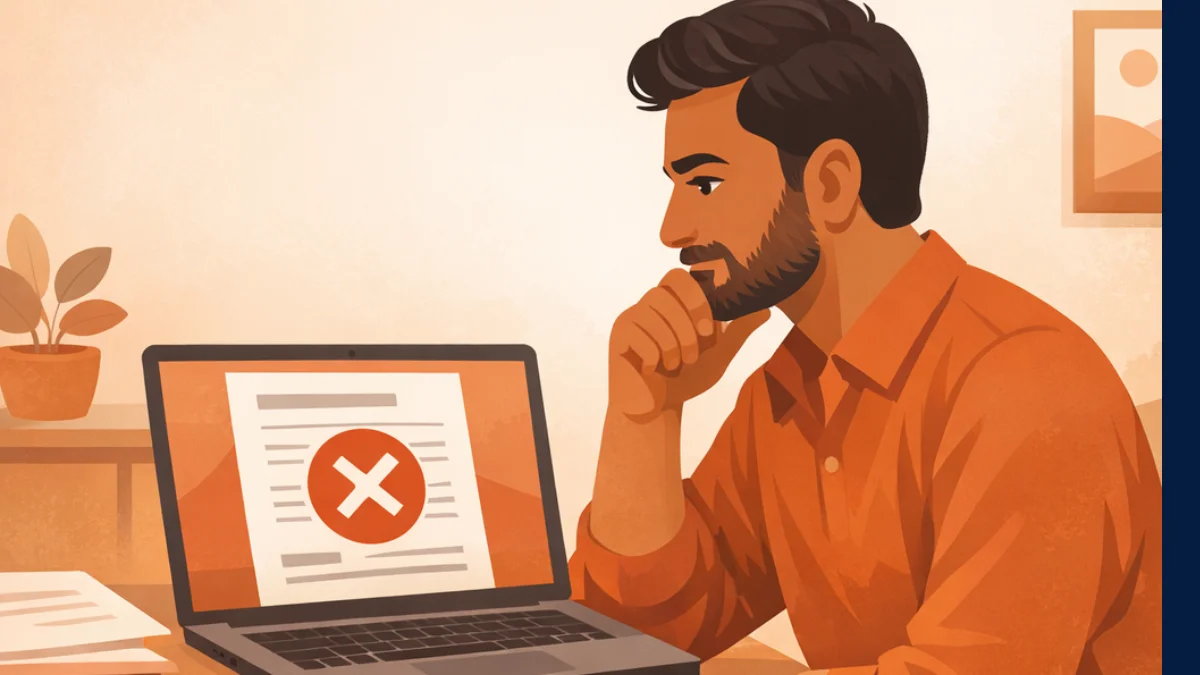
A government scheme application is rejected when the details you submitted do not match official records, when required documents are missing, or when you do not meet the scheme’s eligibility rules. In most cases, the rejection is not final. It is a signal that something in your application needs to be corrected before you can be approved.
Application systems for schemes like PM-KISAN, PMAY, and Ayushman Bharat cross-check your details against Aadhaar, bank, land, and income records. If even one of these does not align, the system flags the application rather than approving it.
Common Reasons Applications Get Rejected
1. Incomplete Documents
Missing a single document, an unclear scan, or an expired certificate is one of the most common causes of rejection. Schemes usually list required documents clearly, but applicants sometimes upload the wrong version, such as an old income certificate instead of a current one.
2. Aadhaar Mismatch
If your Aadhaar name, date of birth, or address does not match your scheme application or bank account, the system may automatically reject the entry. Even a small spelling difference, such as an initial written differently, can trigger this.
3. Bank Account Issues
Many schemes pay benefits directly into your bank account. If the account is closed, inactive, not linked to Aadhaar, or the IFSC code is entered incorrectly, your application or payment may be rejected or held.
4. Income or Land Record Problems
Schemes with income limits or land-ownership conditions rely on official records. If your income certificate is outdated or your land record has not been updated after a family division or sale, the system may reject your eligibility.
5. Duplicate Application
Applying twice, whether by mistake or because a family member applied earlier under the same details, is a frequent cause of rejection. Duplicate detection is standard in most scheme databases.
6. Incorrect Category Selection
Choosing the wrong category, such as applying under general when you qualify under a reserved category, or selecting the wrong occupation type, can lead to automatic rejection since the eligibility rules differ by category.
7. Missed Deadline
Some schemes have fixed application windows. An application submitted after the window closes is usually rejected regardless of eligibility. Always confirm the current deadline on the official scheme page rather than relying on last year’s dates.
How to Read a Rejection Message
Most portals provide a rejection reason, either as a short code or a sentence, in your application status or SMS notification. Read this carefully before doing anything else. The message usually points to one of the categories above, such as “document mismatch” or “bank details not verified.”
If the message is unclear, note the application or reference number and check the scheme’s official helpline or FAQ page to see what that specific rejection code means. Avoid guessing, as reapplying with the same error will likely yield the same result.
What Documents to Check Before Reapplying
Before you submit a fresh application, compare the following across every document you plan to use:
- Full name, spelled exactly the same way on Aadhaar, bank passbook, and the application form
- Date of birth, consistent across Aadhaar and any certificates
- Current address, matching your latest proof of address
- Bank account number and IFSC code, double-checked against your passbook or a canceled cheque
- Income certificate, issued within the validity period the scheme specifies
- Land or property records, updated if there has been any recent change in ownership
Fixing even one mismatched detail before reapplying can be the difference between rejection and approval.
When to Correct, Reapply, Appeal, or Contact the Local Office
- Correct and reapply if the issue is a document error, spelling mismatch, or missing paper that you can fix yourself.
- Contact your bank if the issue is with account status, IFSC, or Aadhaar-bank linkage, as these usually cannot be resolved through the scheme portal alone.
- Appeal through the scheme’s grievance system if you believe the rejection is incorrect despite your documents being accurate. Most major schemes have a grievance or appeal option listed on their official portal.
- Visit your local office (such as the Common Service Center, Panchayat office, or municipal office) if the online process is unclear, if you cannot access the portal, or if the rejection involves a record only a local official can correct, such as a land record.
Keep an Acknowledgment Number and Document Record
Every time you apply, correct, or appeal, save the acknowledgment or reference number along with a screenshot or printout of the confirmation page. Keep copies of every document you upload in a single folder, whether physical or digital.
This record becomes essential if you need to follow up later, since scheme helplines and offices will ask for your reference number before they can check your status.
How to Avoid Agents and Unofficial “Rejection Fix” Services
Be cautious of anyone who offers to get your rejected application approved for a fee, especially if they ask for your Aadhaar number, OTP, or bank login details. Government schemes do not require payment to correct or resubmit an application.
Only use the official scheme website, the official mobile app if one exists, or a recognized government service center such as a CSC. If someone contacts you claiming your application can be “fast-tracked” for money, treat it as a warning sign rather than help.
Official-Source Checklist
Before resubmitting, confirm these directly on the scheme’s official government website:
- Current eligibility criteria
- List of required documents
- Application deadline, if any
- Correct application portal or app
- Grievance or appeal process
- Helpline number for the specific scheme
Government Scheme Application Rejected: FAQs
1. Why was my government scheme application rejected without a clear reason?
Some portals only show a short rejection code. Check the scheme’s official FAQ page or contact the helpline with your reference number to understand exactly what it means.
2. Can I reapply after a rejection?
Yes, in most cases. Once you correct the specific issue that caused the rejection, such as a document mismatch or bank detail error, you can usually submit a fresh application.
3. How long does it take to know if my scheme application is rejected?
This varies by scheme, ranging from a few days to a few weeks. Check your application status regularly on the official portal using your reference number.
4. What if my Aadhaar details do not match my bank account?
You will need to correct the mismatch either through the Aadhaar update process or with your bank, so that both records show identical details before reapplying.
5. Is there a fee to correct or reapply for a government scheme?
No. Correcting details and reapplying through official government portals is free. Be wary of anyone asking for payment to fix a rejected application.
6. Who do I contact if my application keeps getting rejected for the same reason?
Visit your nearest Common Service Center or the relevant local government office, and bring your documents and application reference number for in-person help.
7. Does a rejection affect future applications to other schemes?
Generally, no, since each scheme’s eligibility and application processes are assessed separately. However, unresolved issues like an Aadhaar mismatch can affect multiple schemes until corrected.
Related Reading:
- Complete Guide to Government Welfare Schemes in India (2026)
- PM Kisan Eligibility 2026 — Who Can Get ₹6,000 a Year, and Who’s Excluded
- PM Awas Yojana Urban 2.0 Eligibility 2026 — Full Criteria for All Four Verticals
- Ayushman Bharat PM-JAY Eligibility 2026 — Who Qualifies for Free ₹5 Lakh Health Cover
- Government Scheme Scams: How to Avoid Being Cheated